turismoa@zumaia.eus
 Bulegoa





A Shipbuilders’ Heaven: Zumaia's Prosperous Maritime Past


Anyone who visits Zumaia immediately associates the town with the sea. The harbor, the boats, the rhythm of the tides… all these images play important roles in the collective imagination. However, Zumaia's maritime history boasts another important aspect that is often overlooked: shipbuilding and maritime trade.
For centuries, Zumaia was not only a fishing port, but also a strategic hub for shipbuilding and the promotion of maritime trade.
When we talk about Zumaia's maritime heritage, we are talking about a network of historical, economic, social, and cultural links that has tied the town to the sea. It is not about just one element, but rather the entire mark that the sea has left on the town's identity: on its landscape, its economy, its culture, and its daily life.
A clear example of this is the case of Zumaia itself. Shipyards were key facilities on the Basque coast at various times, with records revealing that back in the 16th century there were already 11 shipyards in the town. By the 20th century that number had risen to 12. These figures are no coincidence. Rather, they reflect the town's technical expertise, its favorable geographical location, and its strong maritime economy.
What kinds of ships were built here? Who worked in these trades? What mark has this activity left behind?
To answer these questions, we delved into Zumaia's maritime heritage with Inaxio Manterola and Goiz Eder Iturain, members of the Beduola Association.
Historically, fishing has not been very important in Zumaia, but shipbuilding and trade have. Some 600 vessels would arrive at the port of Zumaia each year. What factors made this activity possible?
Inaxio Manterola: Along with shipbuilding, trade also played a major role in Zumaia. In the past, cabotage — which involved transporting goods and passengers between ports — was a widespread practice. The ships would leave Pasaia, stop in Zumaia, and then continue on to Bilbao, Santander, Gijón, or even A Coruña. It was like a kind of cruise, but cheaper. These ships transported scrap metal and cement, as Arroa, Narrondo, and Zumaia were some of the main cement production and loading points in Europe. That was one of the key factors.
All that activity made Zumaia an important port, right?
I.M.: In addition to the cement factories I mentioned, the minerals found in the area were also very important. Here, in places like Bedua, a special type of cement called hydraulic cement was produced; this type hardens quickly under water, which is why it was widely used in port construction.
Goiz Eder Iturain: We can't overlook the importance of the Urola Railway. Cargo ships would arrive at the port of Zumaia bringing coal from Asturias, which was essential for the cement factories, and scrap metal for the iron industry. All of this was loaded onto the train and taken to Zumárraga, stopping at the Marcial Ucin company in Azpeitia. On the return trip, the train came back loaded with cement to supply the ships. As a result of all this, Zumaia became a very important freight port.
However, the port of Zumaia was important long before all this. Records show that in the 16th century the town listed 11 shipyards. What level of activity does that imply? And, when did its decline begin?
G.E.I.: From Oikia to Zumaia, there were a great number of shipyards, all located very close to one another. They had a significant advantage: the forests in the area were of oak trees, and they were well cared for. Oak was the best wood at the time, and it was abundant throughout the Urola Valley.
What does the Beduola Association do to raise awareness of this heritage?
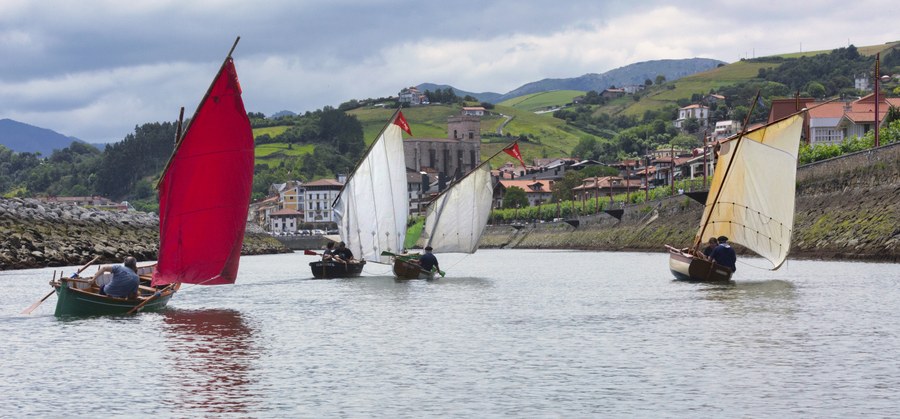
I.M.: First, there's the tangible heritage: small vessels, boats, and so on. Many of them sank or were lost because, at the time, preserving them wasn't considered important. Beduola isn't Albaola, but, to the best of our ability, we are salvaging the small wooden boats that still remain. As for intangible heritage, we're trying to recover knowledge: to understand how boats were built, how sailor's knots were tied, what the fishing techniques were, and so on. Fortunately, there are still people in Zumaia who are very knowledgeable about such things, and we are trying to learn from them. Our goal is to preserve both the tangible and intangible aspects of our heritage.
G.E.I.: As for our intangible heritage, we would like the people of Zumaia, especially children, to reconnect with the water. In the past, rowing in bateles (the area's traditional skiffs) gave people a direct connection with the sea. Today, that connection has changed, and it would be wonderful to regain that feeling of touching the water in a batel.
Where and how can people see or learn about this heritage?
I.M.: We don't have a permanent exhibition, but we regularly organize activities using the boats that we restore: we open the place, put up information panels, and launch the boats on the water, among other things. All the boats are usually in the estuary; we'd like to be able to bring them all together in one place, but we don't have a location for that.
G.E.I.: In addition, every two years, we try to raise awareness of our work by organizing exhibitions, offering local residents the opportunity to go out on the boats, and more. We also take part in events organized by other batelero associations, such as Batelero Eguna.
I.M.: We'd love to be able to use the last shipyard that closed in Zumaia, the Bedua shipyard, because it would be an ideal place to gather all our boats. the facilities would be perfect for our work, but it's privately owned, which complicates things. We are certain that having a pier at the port of Zumaia would help us promote our heritage. That would allow us to display all the boats, along with their histories and relevant information. We would gain visibility, but we don't see any willingness to assist on the part of the Basque Government. It's a shame; they have no interest in promoting our heritage.
G.E.I.: It is essential to understand what heritage is and how important it is. We believe it is absolutely essential to preserve this heritage and raise awareness of it, and to do that, we need support.