turismoa@zumaia.eus
 Bulegoa





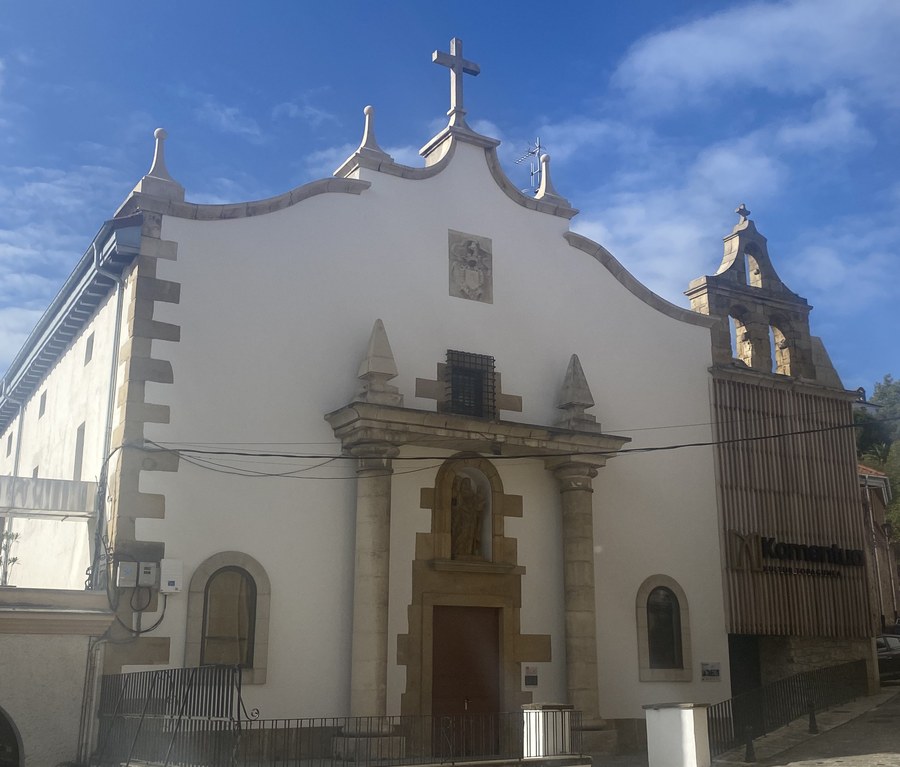
Saint Joseph’s convent: A Hidden Treasure of Zumaia’s history


If you stroll through Zumaia’s Old Quarter, you’re likely to come across traces of centuries of history. Among its well-known streets and buildings, however, there are lesser-known corners, and one of these is the Saint Joseph’s convent.
This building, standing within the town walls, holds part of Zumaia’s history, and its origins are linked to those of Frantzizka Labaien. But to understand its history, we first need to know something about her father, Juan Labaien.
After voyaging to the New World to seek his fortune, sailing the transatlantic trade route known as the Carrera de Indias, in 1583 Juan Labaien returned to Zumaia, where he took up shipbuilding, and at the Eskazabel shipyard he built, among others, the 500-tonne vessel San Miguel. He also played a prominent role on Zumaia’s town council, serving several terms as a councillor between 1584 and 1597.
Frantzizka Labaien was Juan Labaien’s only daughter. In 1614 she founded the first Gipuzkoan monastery of the Discalced Carmelites in Zumaia.
Earlier, in 1609, Labaien had decided to gift her tower house to the Carmelite community, which is how the convent that followed the Teresian reform came into being. This decision, taken by a woman four centuries ago, left a clear mark on Zumaia’s heritage, turning the tower into a convent.
The convent’s origins, thus, can be traced to the Labaien family’s tower house, a building whose simplicity evokes the austerity of the Carmelites’ way of life, and whose walls have borne witness to the life of the community for centuries.
Frantzizka’s name lives on today, as one of the convent’s rooms is named after her: the Frantzizka Labaien room.
Over time, the convent has been put to new use: today it is a cultural meeting centre used by local creators and groups for talks, meetings and other activities.
Outside the building there is another recognisable corner: the garden is one of the most distinctive green spaces in Zumaia’s Old Town. Over the years it has boasted fruit trees and orchards, and it is also home to the prayer space dedicated to St James the Apostle.
In 2026 the Town Council renovated the garden and opened it to the public. Since then, it has offered another space for rest within the Old Town.
Another Way to Discover Zumaia
When we think of Zumaia, the first thing that comes to mind is the flysch, the sea, and the beaches. But our town’s heritage isn’t found only on the coast. In the streets of the Old Quarter there are also buildings and corners steeped in stories of yesteryear.
The Saint Joseph’s convent is one such example. You’ll find it as you stroll through the historic quarter, among the church of San Pedro, the tower houses and other heritage features. And there, inside a historic building, you can discover another side of Zumaia: history, culture and tranquillity, all in one place.
So, if you’re exploring Zumaia’s Old Town, it’s worth stopping at the convent. Within its walls you’ll find a building tied to the town’s history and a venue now used on today’s cultural scene.