turismoa@zumaia.eus
 Bulegoa





Zumaia, Built On the Strength of Cement


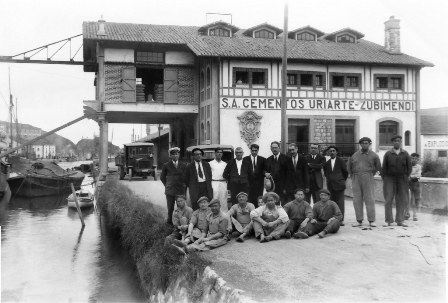
Cement manufacturing played a pivotal role in Zumaia, serving as the catalyst for local industrial development and transforming both the town’s economy and social structure. Although this activity has since ceased, it laid the foundations for modern Zumaia.
Cement production began around 1838, during the First Carlist War, using Ibañarrieta stone and lignite from Mount Ertxiña as raw materials. The product quickly gained an international reputation, particularly for its excellent properties in hydraulic works, and became known as Zumaya Cement. Even on fishing boats in the Cantabrian Sea, it was commonly used to plug holes due to its rapid hardening properties.
The founding and expansion of Zumaia’s cement factories can be divided into two distinct stages. In the first, the factories were simple facilities built from marl and lignite-fired kilns, so they were constructed as close as possible to the quarry in the Ibañarrieta-Agote area. During that period three companies were in operation: Santa Cruz, owned by Corta y Compañía, in Agote; Nuestra Señora de los Dolores, owned by Eusebio Gurruchaga, in Arroabea; and Oiquina, owned by Olaizola y Compañía (Fábrica del Conde de Villafranca), in Oikia.
It was then that the first modern factories emerged, combining furnaces and grinding mills at a single site. Eusebio Gurruchaga was the pioneer in making this leap, building the Nuestra Señora de los Dolores factory in Arroabea in 1858.
In the second stage, at the end of the 19th century, and following the success of Gurruchaga’s company, more businesses adopted this model. The natural cement from the Lower Urola region earned such a great reputation that the name Zumaya came to be applied to all natural cement produced in Gipuzkoa, becoming synonymous with high quality.
This period of expansion was followed by decline, however. The crisis began in 1907, when two companies closed. The interwar years, particularly after 1936, were especially difficult, and many factories were forced to shut their doors.
After the Civil War, the cement companies in the area began a reorganization process. Although there was some recovery during those years, competition from Portland cement remained very strong. In the 1970s, the market favored only large producers: Bedua closed in 1972, and in 1975, Rezola absorbed Alberdi. Finally, in 1999, the cement plants in Zumaia closed permanently, with the Arroabea factory ceasing operations.
For over a century Cementos Zumaya was a key industrial symbol of Zumaia and a vital economic and social cornerstone. It created jobs, stimulated social life, and significantly contributed to the modernization of the municipality. However, its activity also left its mark on the landscape and the environment. Today, its remnants—buildings, facilities, and the collective memory of its citizens—are part of the local industrial heritage. The history of Cementos Zumaya is, therefore, an essential testament to Zumaia’s industrial past and a valuable source of reflection for its future.