
 turismoa@zumaia.eus
 Bulegoa





The Hermitage of San Telmo, the guardian of on an exceptional geological outcrop


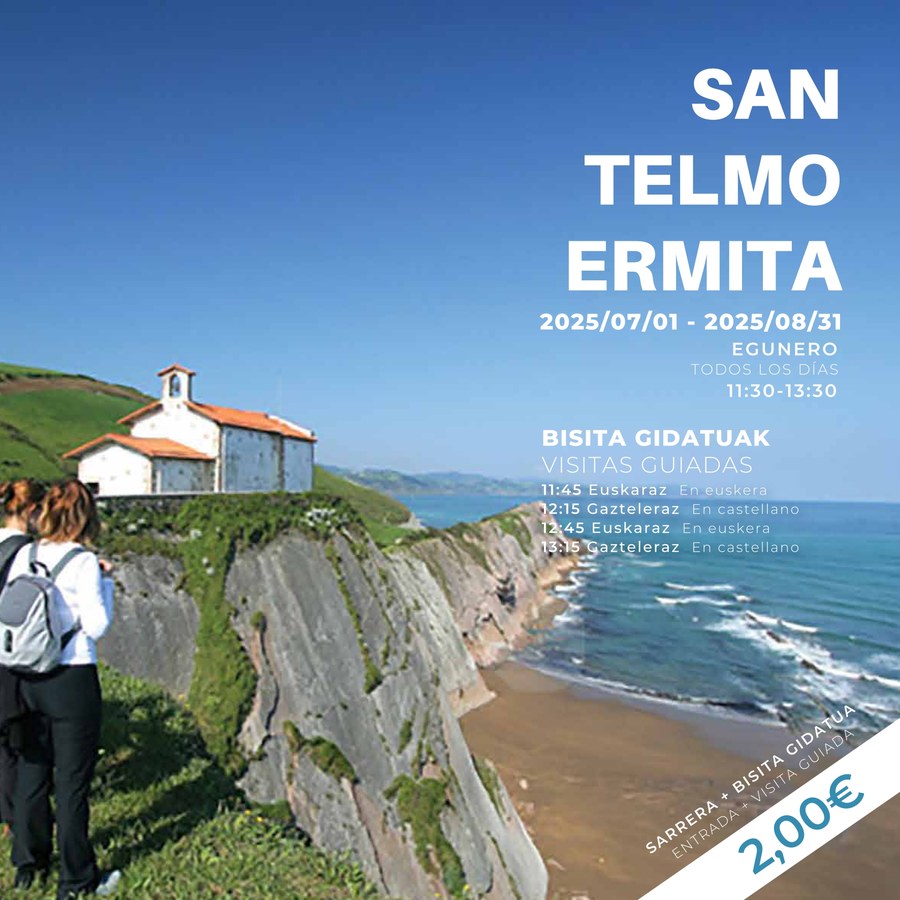
On the edge of the cliffs of Itzurun Beach, the Hermitage of San Telmo seems about to plummet into the sea.
It has a rich history, dating back to the 16th century, as the first written references to it date back to 1540.
Some 45 meters up, the hermitage combines magic and mysticism, endowing Zumaia's landscape with a special splendor. It is the town's most prominent icon; you'll have seen it in countless photographs and television programs, and it's worth the ascent, as the view from there will leave you speechless.
Beyond that, however, even more unique than the spectacular landscape is the setting where the hermitage is located. It is a strategic point to observe the geological outcropping of the Itzurun-Algorri area, one of the most significant places on the Basque Coast UNESCO Global Geopark. In fact, there are several golden spikes in the area. Do you know what they are? These spikes define boundary stratotypes, which means that this is the best place in the world to study that moment in Earth's history. There are five in Spain, and in Zumaia we have two of them at the foot of the Hermitage of San Telmo. Zumaia's Paleocene internal boundaries became a global reference and stratotype in 2008. Both are marked by a golden spike: the Danian/Selandian boundary, a mark left by a drop in sea level that took place 60.5 million years ago; and the Selandian/Thanetian one, evidence of the change that the Earth's magnetic field underwent 58.7 million years ago. There are two other boundaries that were also stratotype finalists: the Cretaceous/Paleogenic (or K/T) and the Paleocene/Eocene boundaries, all of them located in this beautiful area between Itzurun and Algorri.
And, if all that can be seen on the outside of the hermitage were not enough, its interior also boasts several curiosities. Along with the images of St. James (Santiago) and Santa Clara, the 18th-century Rococo altarpiece stands out, made of wood, without polychrome or gilding. Another little-known fact is that as of the 16th century this hermitage was the headquarters of the Cofradía de Mareantes de San Telmo (Mariners’ Guild Hall). In the last years of its existence, however, it was located on the Erribera kalea, where now one can find the only fish auction machine remaining in the Basque Country.
The hermitage's legacy is rich, with numerous stories and ancient curiosities surrounding it. If you want to know everything, you can do so this summer, as the City of Zumaia has organized guided tours that last 10 minutes, are offered in Basque and Spanish, and cost just 2 euros. For more information, you can find everything you need at the Tourism Office.
Ever since ancient times, the Hermitage of San Telmo has been a witness and heir to thousands of stories about the sea, surrounded by legends passed down from generation to generation, collecting anecdotes over the course of its history. Learn all about them this summer. Don't think twice!
Albiste erlazionatuak
#santelmo
#zumaia
- Aztarna uzten duten paseoak Oct 15, 2025
- A Different Day in Zumaia Aug 01, 2025
- Une journée différente à Zumaia Aug 01, 2025
- Un día diferente en Zumaia Aug 01, 2025
#geology
- A Different Day in Zumaia Aug 01, 2025
#flysch
- Aztarna uzten duten paseoak Oct 15, 2025
- A Different Day in Zumaia Aug 01, 2025
- Une journée différente à Zumaia Aug 01, 2025
- Un día diferente en Zumaia Aug 01, 2025